Everything that has been digitised has been learned. Text, code, images, speech: anything that fits on a screen now has a model that gets better at it every few months.
But the digital world is a thin film over the physical one, and by our estimate it captures less than 0.001% of it. Under the film are the atoms. Every object that has to be lifted, turned, opened, stacked or carried is still moved by a hand.
If you can build something that improves itself in the physical world, you unlock realities humans can't yet imagine. It starts with a world where you don't have to lift a finger to move anything, and it ends with every atom around you being manipulated at will.
Every leap forward has come from learning beyond the limits of reality
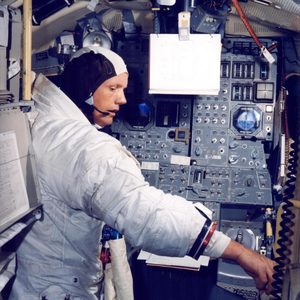
1969
The limitApollo landing procedures had to account for uncertain computer alarms. One wrong abort call could end the mission.
The world built to learn inSimulated lunar landings that rehearsed alarms and abort decisions
What it unlockedApollo 11 flew through the real 1201 and 1202 alarms and landed on the Moon
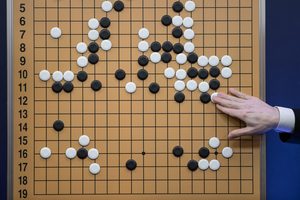
2017
The limitGo AI learned from expert human games. Human knowledge capped where discovery could start.
The world built to learn inAlphaGo Zero played millions of games against itself
What it unlockedSuperhuman play with no human game data
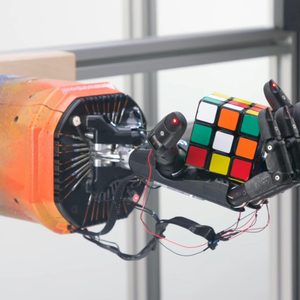
2019
The limitRobot dexterity depended on real-world experiments. Physical data was slow and expensive.
The world built to learn inA robotic hand trained in simulations that grew more randomized as it improved
What it unlockedA real robot hand solved a Rubik's Cube
2026you are here
The limitRobots learn from demonstrations in the physical world. Expensive, slow and dangerous.
The world built to learn inInfinite worlds for robots to learn in
What it unlocks???
Next
A world where nobody has to lift a finger to move anything.
Here are ten frames from the same robot stations. Some come from the real robot, and some from our simulation of it. Mark each one sim or real, then check your score. Every round draws a new set of ten from a pool of 98.
0 / 10 answered
Answer all 10 to see your score.
0 / 10
Real frames come from published evaluation runs of the ABC model. Sim frames are the same tasks rebuilt in our simulation and path-traced.
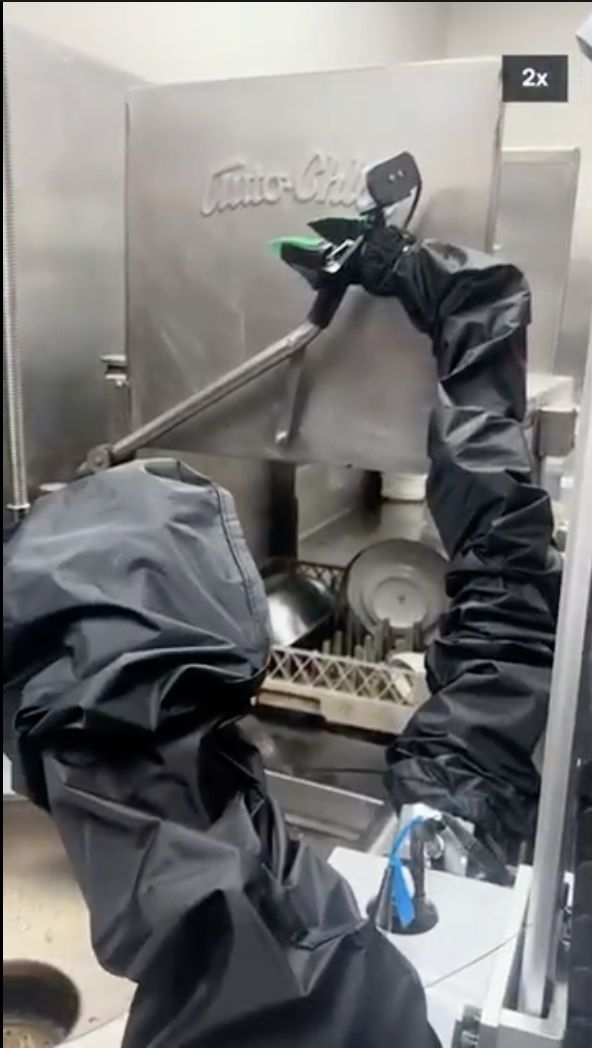
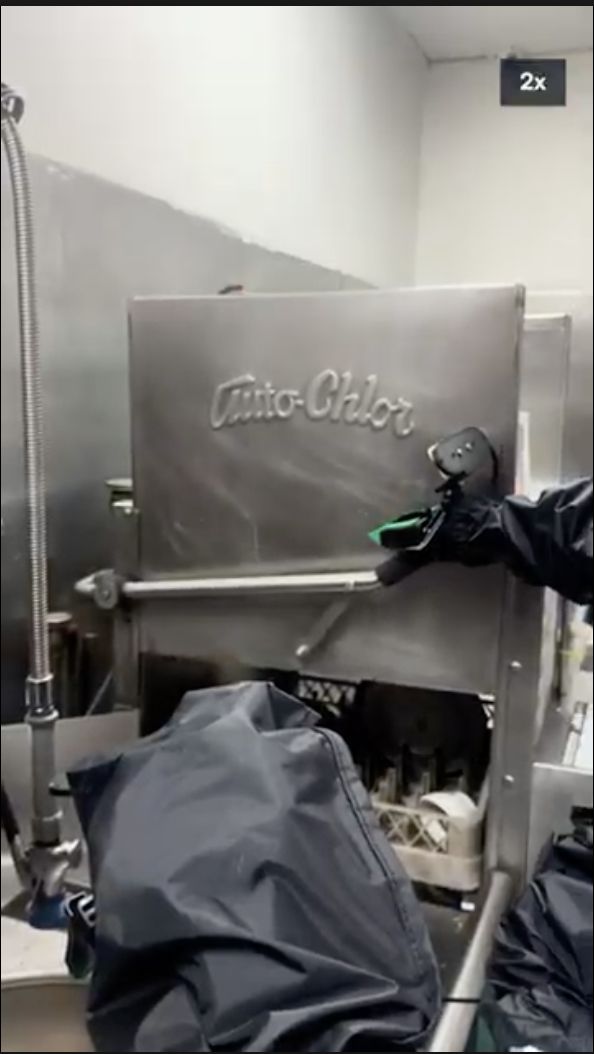
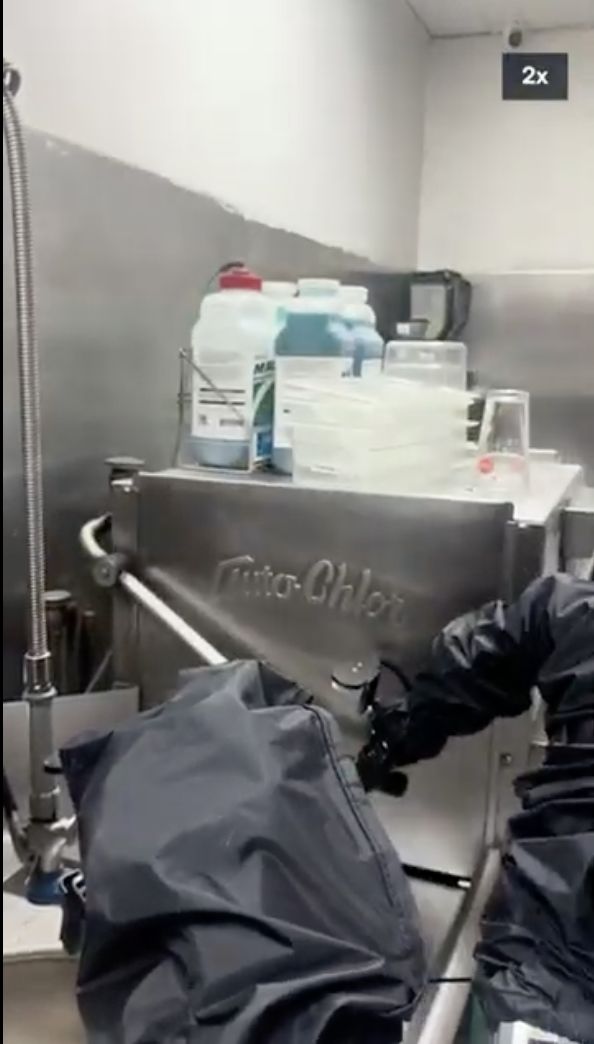
The robot closing a commercial dishwasher in a customer's kitchen, played at 2×. It had no real-world data for this task.Watch the video ↗
Discovery-0 is our first demonstration that what a robot learns in our simulated worlds carries over to the real one. A model trained only on trajectories from simulation closed a dishwasher zero-shot in a live customer kitchen. We could not get this task working before, even with significant fine-tuning and teleoperated data collection.
Learning only inside the worlds
The robot then learned from trajectories it generated in those simulated worlds. For closing the dishwasher, we collected no real-world data at all: no demonstrations, no teleoperation, no fine-tuning on the customer's site.
Zero real-world data for this task.
Then we ran the model on the real robot in the real kitchen. It closed the dishwasher. The skill it had learned in our virtual kitchens transferred directly to the physical one.
The robot learned to drop the plate
The dishwasher was not the only thing the model figured out. In simulation, a plate got stuck at the edge of the rack, in a pose the gripper couldn't grasp well. Instead of retrying the same grasp, the model pushed the plate down, let it slide, and picked it up again from a better position.
In simulation, the model pushes the stuck plate down, lets it slide, and picks it up again. Overview camera on the left, wrist cameras on the right. Nobody showed it this recovery; it found it while exploring.
Dropping something on purpose so you can pick it up better is the kind of move people make without thinking, and the kind nobody writes into a dataset.
This discovery is not alone
There were more than 300 techniques that we traced back to sim explorations. This behaviour was not present in any data.
This loop is super useful. The virtual world proposes endless possibilities on model finding techniques to navigate the real world. Each discovery becomes something the model can build on, which is what we mean by recursive learning.
Technical breakdown
We will be releasing the complete pipeline, with the technical details of each block, in the coming days.
Speed is the final frontier that needs to be unlocked before we can see robots assisting humans in the real world.
Speeding up robots is a chicken-and-egg problem: you need deployments in the real world to collect data and iterate on models, but you need fast models in the first place to provide enough economic value to earn those deployments.
Several companies like Physical Intelligence1,2, Skild AI, Generalist AI, Reward AI have shown impressive demos of their models working at impressive speeds, but the fundamental lever behind that is very fast demonstration data, which does not hold once you start scaling a fleet into the real world. We have spent the past few months deploying across various industries, and here is what we, along with several other companies actually deploying robots on the ground, have seen.
Why is deployment data slow?
Operators in live deployments run two to four times slower than operators in demo setups, for a few key reasons:
Assistance has to be remote to scale. Sending an operator to every site breaks before you reach even a hundred deployments. Remote operation lets one office of trained operators serve many sites without downtime, which makes it the only viable path to human-assisted deployment at scale. Remote teleoperation is slower because it is hard to perceive depth intuitively from camera views; building a 3D environment inside a Meta Quest is a good technical solution, but nobody can use one for more than an hour without feeling nauseated.
The control interface differs. Many demo datasets use leader follower arms3,4, which tie operator speed to physical arm speed. Deployments need dynamic speed adjustment like going slower near humans and fragile objects, for safety, etc. Most deployments we have seen use Meta Quest controllers, which track the operator's hand and move the arm accordingly.
There is no predictability. Demo scenes are structured and learnable, so operators can act before they think. In a real deployment, an operator has to react to live cues, which is inherently slower.
Why is slow data a problem?
Slow teleoperation hurts deployment and scaling in two ways:
Weak learning signal. Current robotics policies work by predicting the next chunk of actions. Data in which most of the motion is idle, or does not contain significant movement, carries poor information for a policy to learn from. We have seen this directly in our training runs: policies trained on such data are not only slower but usually less accurate, because each next-chunk prediction offers little progress toward completing the task.
Economics. When a policy or a teleoperator runs significantly slower than a human, it becomes impossible to create economic value for the end customer especially in environments such as kitchens and warehouses, which have been optimised around humans doing tasks quickly and efficiently.
Over the past six months we have run policies in live deployments and focused our engineering and research effort on making policies run faster than the teleoperation data they were trained on, so that we can deploy our robots at scale. We have found three levers that make policies faster while maintaining accuracy:
1. Adaptive speed-up of the training data
The simplest approach you could think of is to speed up the training data and then train a model on it. Unfortunately, that works poorly in practice: you lose a lot of key information when you discard frames from the data you collect. Uniformly dropping every other frame (2x) took success from 94% to 53%, and at 4x uniform it collapsed to 9% for plate picking, handover between arms and release. The failures concentrated at the grasp and the release, exactly where the discarded frames carried the most information.
A better and more effective approach, also observed by many others in the field, is to treat the motion of the arms as two separate parts: free-space motion, where the arms are travelling toward their target region, and contact-rich motion, where the arms are interacting with the real world. Free-space motion contains far less information about manipulation than contact-rich motion, so it makes sense to speed up free-space motion while keeping contact-rich motion intact.
Prior works such as AutoSpeed5, SAIL6 and SRIL7 have consistently used an RL head to predict contact-rich motion and perform speed-ups around it. We were able to achieve similar or better results without training an RL head at all, by simply treating any motion within x seconds of a gripper event (gripper opening or closing) as contact-rich motion; trying everything from 0.1 to 2 seconds.
We ran hundreds of ablations at 2x, 3x, 4x, 5x and 10x, and across different contact-identification techniques, and saw the best results at 4x with actions within 0.5s of gripper events being classified as contact. Beyond 4x the arm still reaches the object, but it arrives with too much residual velocity to close the gripper cleanly, and success falls off sharply.
Free-space speed-up
End-to-end task time vs. teleop data
Success rate
1x (raw teleop data)
1.00x
94.2%
2x
1.82x
96%
3x
2.63x
97.4%
4x
3.41x
95.6%
5x
4.02x
82%
10x
6.2x
11%
Contact window fixed at x = 0.5 s; each row is 500 real-robot runs on the same task and scene.
2. Selective chunk skipping at inference
A VLA policy predicts several chunks of future actions at once. Skipping chunks makes the policy run faster by letting the arm jump to future states, with no retraining. Doing this naively causes two problems, and both of them push the policy out of distribution quickly:
Far-out predictions are less accurate. The further out a chunk is, the less likely it is to be accurate, because the world will have changed by the time the first few actions have been executed. The general practice is to query the model often and execute only near-term chunks.
Skipping causes jitter. When you skip chunks, the arm moves through a different distribution than the training data, and the video feed from the real world no longer corresponds to the training data, which takes the model out of distribution very quickly.
To solve these issues, our approach after running thousands of tests in the real world is to estimate the risk before skipping a step. We look at the motion predicted by the policy and skip only if both of the following conditions hold:
The predicted chunks sit close together in the real world. We measure the end-effector displacement between the last pose of the current chunk and the last pose of the chunk we would skip to, and require it to stay under x cm at 20 chunk executions per second. That threshold is not fixed: a VLM scores the current camera view for scene complexity i.e. clutter, number of movable objects, proximity of a human into 5 buckets, and we scale the allowed displacement from 2 cm in a clean, static scene down to 0.3 cm in a cluttered or human-occupied one. The intuition is that displacement is only safe if the world will still look the way the policy expects when the arm arrives.
There must be no gripper event inside the skipping window.
The second condition is essential. Every time we skipped chunks through a gripper event, the task fell apart. Restricting skips to slow, contact-free motion keeps the policy in distribution. With these techniques we achieve another 22 percent speed-up over our fastest policy.
3. DAgger-style intervention data
Intervention data is the most useful and most unexpected lever for speeding up a model. We expected it to increase accuracy which it does, at roughly 30x the per-frame value of ordinary teleoperation data. But with no other changes, the policy also gained a 10–15 percent speed-up simply from adding intervention data, sped up using the same techniques described above.
The setup follows DAgger (Ross et al., 2011)8. The policy runs on the robot, and an operator takes control the moment it starts to fail. We then speed up that intervention data with the same gripper-event rule from Lever 1 and retrain.
For models trained at lower speeds, intervention data barely helps with speed, so there is effectively zero speed-up. For policies trained at a faster speed, sped-up intervention data helps them grow faster and faster.
Base policy (training-data speed)
+ intervention data
Success rate
Speed vs. base policy
1x
—
94.2%
1.00x
1x
200 interventions
96.6%
1.01x
2x
—
96%
1.82x
2x
200 interventions
96.2%
1.93x
4x
—
95.6%
3.41x
4x
200 interventions
97.2%
3.92x
Final results
Combined, the three levers let us run our policies nearly four times (3.97x) faster than the data we collected from remote teleoperation. In the table below we report speed alongside accuracy as we add each lever:
Configuration
Median task time
Speed vs. teleop data
Success rate
Teleoperation data (reference)
37.3 s
1.00x
100%
Policy trained on raw data
41.2 s
0.9x
94.2%
+ Lever 1 (adaptive 4x speed-up)
12.1 s
3.08x
95.6%
+ Lever 2 (risk-gated chunk skipping)
9.9 s
3.76x
93.8%
+ Lever 3 (sped-up intervention data)
9.4 s
3.97x
95.2%
Setup. All results are on a bimanual cell of two AgileX PiPER six-DoF arms with parallel-jaw grippers, with three RealSense cameras (one overhead, one per wrist) recorded at 20 fps, driven over CAN from a Jetson Orin NX 16 GB. The policy is π0.52, with an action chunk of 30. Training data is 10 hours of remote teleoperation collected in the same deployment across seven days plus around one hour of usable teleoperation intervention data. Each number in the tables is 500 real-robot runs, with object positions re-randomised between runs.
Limitations
These results come from a narrow set of tasks: picking up plates and dishes, and picking and placing objects. We have yet to test whether the gripper-event rule and the 4x optimum hold across a more diverse task set. We also have no explanation yet for why 4x outperforms both lower and higher factors.
What comes next?
We expect our policies to soon run significantly faster than any human can control them, on specific tasks. To build superhuman policies, human data alone cannot get us there.
Human intervention data plays a role in robotics similar to the one RLHF9 played in the early days of LLM post-training. The field had to move past human feedback as models improved, because the models began to outperform expert annotators by too wide a margin. Robotics will hit the same wall in six to eight months.
Our next line of research is RL post-training with no humans in the loop. We plan to apply techniques in the GRPO10 and DAPO11 family to robot policies, with the goal of pushing speed beyond human capability while holding accuracy at similar levels.
References
π0: A Vision-Language-Action Flow Model for General Robot Control Kevin Black, Noah Brown, Danny Driess, et al. 2024. arXiv:2410.24164
π0.5: a Vision-Language-Action Model with Open-World Generalization Physical Intelligence, Kevin Black, Noah Brown, et al. 2025. arXiv:2504.16054
Learning Fine-Grained Bimanual Manipulation with Low-Cost Hardware Tony Z. Zhao, Vikash Kumar, Sergey Levine, Chelsea Finn. RSS 2023. arXiv:2304.13705
GELLO: A General, Low-Cost, and Intuitive Teleoperation Framework for Robot Manipulators Philipp Wu, Yide Shentu, Zhongke Yi, Xingyu Lin, Pieter Abbeel. 2023. arXiv:2309.13037
A Reduction of Imitation Learning and Structured Prediction to No-Regret Online Learning Stéphane Ross, Geoffrey J. Gordon, J. Andrew Bagnell. AISTATS 2011, pp. 627–635. arXiv:1011.0686
Training Language Models to Follow Instructions with Human Feedback Long Ouyang, Jeff Wu, Xu Jiang, et al. NeurIPS 2022. arXiv:2203.02155
DeepSeekMath: Pushing the Limits of Mathematical Reasoning in Open Language Models Zhihong Shao, Peiyi Wang, Qihao Zhu, et al. 2024. arXiv:2402.03300
DAPO: An Open-Source LLM Reinforcement Learning System at Scale Qiying Yu, Zheng Zhang, Ruofei Zhu, et al. 2025. arXiv:2503.14476
Citation
Please cite this work as:
@article{argon2026speedingup,
  author  = {Pranay Gupta and Deepanshu Rohilla},
  title   = {{Scaling and speeding up robots in the real world}},
  journal = {Argon Robotics Blog},
  year    = {2026},
  month   = {September},
  url     = {https://www.argonrobotics.ai/speed},
}